Showing posts with label simple. Show all posts

Thursday, September 26, 2013

Simple 6 Input Alarm

This simple alarm circuit was designed for use in a combined garage and rumpus room. It can be assembled on Veroboard and uses just one IC plus a handful of cheap components. The circuit is based on a straightforward 555 timer circuit (IC1). This is wired as a monostable and sets the siren period which is adjustable up to about three minutes using potentiometer VR1. In operation, IC1s pin 2 input monitors the detector circuit for negative-going signals. When a switch is closed, a brief negative-going pulse is applied to pin 2 via a 10µF capacitor and its corresponding series diode (D2-D7). This triggers IC1 which switches its pin 3 output high and switches off relay RLY1 (ie, RLY1 is normally on).

Simple 6-input alarm circuit schematic

As a result, the piezo siren sounds for the duration of the monostable period. In addition, relay RLY2 is turned on via diode D9 and latches on via D10. This means that the strobe light (which is wired to the normally open contact) will continue to flash until the alarm is switched off (via the keyswitch). At the end of the monostable period, RLY1 turns off and this turns off the piezo siren. The circuit can then be retriggered by any further trigger inputs from the switches. A variety of detectors with normally open contacts can be used for the switches, including reed switches, pressure mats, IR detectors and glass breakage detectors. All switches must be open before the alarm is switched on.
Continue Reading..

Friday, April 12, 2013

Simple Stereo VU Meter

I like to peer gentles transfer to music. This venture will point out the volume level of the audio going to your audio system with the help of lighting fixtures up LEDS. The LEDS will additionally be any shade so combine them up and in point of fact make it seem to be good. The input of the circuit is connected to the speaker output of your audio amplifier. You wish to construct two equivalent units to point out each proper and left channels. The input signal degree is adjusted by using the 10k ohm VR. If you wish to make an extraordinarily huge scale edition of this unit and dangle it on your wall there's an not obligatory output transistor that can power many LEDS immediately. The unit I built drove three LEDS for every output. The sequence of the LEDS lighting are as follows Pin 1, 18, 17, sixteen, 15, 14, 13, 12, eleven, 10.


Continue Reading..

Wednesday, April 10, 2013

Simple Digital Switching System

This circuit can control any one out of 16 devices with the help of two push-to-on switches. An up/down counter acts as a master-controller for the system. A visual indication in the form of LEDs is also available.  IC1 (74LS193) is a presettable up/ down counter. IC2 and IC3 (74LS154) (1of 16 decoder/demultiplexer) perform different functions, i.e. IC2 is used to indicate the channel number while IC3 switches on the selected channel.

Digital Switching System Circuit Diagram :
Digital Switching System-Circuit Diagram

Before using the circuit, press switch S1 to reset the circuit. Now the circuit is ready to receive the input clock. By pressing pressing switch S2 once, the counter advances by one count. Thus, each pressing of switch S2 enables the counter to advance by one count. Likewise, by pressing switch S3 the counter counts downwards.

The counter provides BCD output. This BCD output is used as address input for IC2 and IC3 to switch one (desired channel) out of sixteen channels by turning on the appropriate triac and the corresponding LED to indicate the selected channel.  The outputs of IC3 are passed through inverter gates (IC4 through IC6) because IC3 provides negative going pulses while for driving the triacs we need positive-going pulses. The high output of inverter gates turn on the npn transistors to drive the triacs. Diodes connected in series with triac gates serve to provide unidirectional current for the gate-drive.

Sorce : www.ecircuitslab.com/2012/08/digital-switching-system.html
Continue Reading..

Tuesday, April 2, 2013

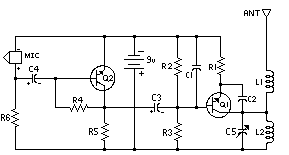
Simple FM transmitter with 2N3904

simple FM transmitter
In this section discuss about the series of mini fm transmitter, with broadcast coverage of about 300-400 meters. when using a 9 volt working voltage, the transmit power of about 300 meters and when using the working voltage 12 volts, the range of about 400-450 meters, depending on the antenna you use.

This scheme of simple fm transmitter
simple FM transmitter

For L1 and L2 windings 5 times the wrap, you can use a pen to fill melilitnya so neat and after lepaslah content of these pens. C5 is used for placement of broadcasting frequencies, can be tuned between 88-108 mhz, to reach further use steering antenna or Yagi antenna.

Part List
C1 = 0.001uF
C2 = 5.6pF
C3 = 10uF
C4 = 10uF
C5 = 3 - 18pF Adjustable capacitor
R1 = 270R
R2 = 4.7K
R3 = 10K
R4 = 100K
R5 = 4.7K
R6 = 4.7K
Q1 = 2N2222A
Q2 = 2N3904
L1 = 5 turn
L2 = 5 turn
Continue Reading..