Showing posts with label to. Show all posts

Friday, January 10, 2014

Other important factors to be considered

Other important factors to be considered are the Settling time and ringing and the Stability Factors.
In the field of electronics, amplifiers and their performance play a key role in any audio-visual equipment. The best systems will be judged only by the quality of their sound output. Some of the following points can help you to make up your mind. The Power Rating indicates the power of the amplification. You can buy one amplifier for all the speakers or you can have an amplifier for each speaker. Amplifiers also perform cross- over functions. You can assign high frequencies to one set of speakers and low frequencies to another set.
Equalizer is a programme that controls frequencies of signals by mixing channels. This can be programmed until you get the output that suits your ears. Choose an amplifier that has the least distortion factor. The above pointers ought to help you buy am amplifier that helps you enjoy high fidelity music at home or in your car without any distortion.Amplifiers are essentials not just for electric musical instruments, but for a whole slew of other devices including cars, radios, videos, transistors, and so on. Essentially, an amplifier is any device that increases the output signal of another device. The most common kind of amplifier for sale is the kind used in music or speech devices. This category also has many different kinds, so get to know whats out there before you make your purchase.An amplifier will be a great add on to your instrument or sound system because it will improve the volume and quality of the sound produced. In cases such as performances, or even just watching a much-awaited movie on DVD, having great, maximum sound output is necessary.
Smaller speakers should also be set up to get the frequencies they need. If amplified, these speakers almost always should have a crossover attached to ensure that big bass tones wont damage the speakers designed for midrange response and high frequencies. Dividing the sound into low, middle and high frequencies using the different types of speakers creates a medley of tuned sound that gives the experience we want from our systems.
Pay attention to ohms and power ratings, and be sure to match all accordingly.
Continue Reading..

Wednesday, September 11, 2013

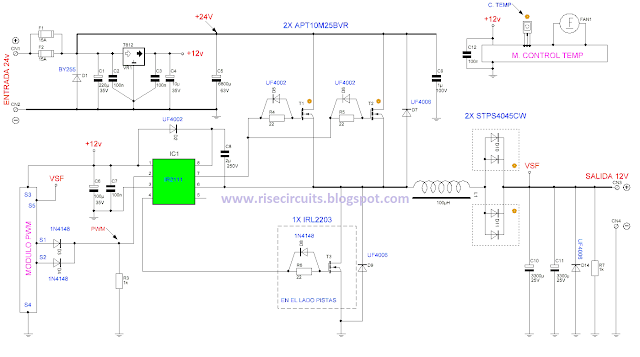
24V to 12V 400W DC Inverter Circuit

24V to 12V 400W DC Inverter Circuit Diagram
24V to 12V 400W DC Inverter Circuit

24V to 12V 20A 400W DC to DC Inverter. Does little to change my PV system 12v 24v me the problem arose of what to do with investors who already had 12V. I was looking for a pattern online and found several schemes with linear regulators 20A, this solution although quite simple, due to the huge losses they have is not advisable. Ideally, a converter switched, high-performance. At the end I found nothing I liked and decided to design my own. Circuit characteristics: Output current: 20A at 12V (15A continuous and 30A Momentary), Input voltage: 18 to 30V DC, Output voltage: 5 to 20V, Operating Frequency: 70kHz, Effectiveness: 95%, 400W maximum power, Protections: Above current (30A) in the F1 circuit, D1 and F1 polarity in the circuit.
Continue Reading..

Wednesday, June 12, 2013

Simulation of small frogs flashlight ready to bring you happiness

If you see this cute frog night do not really Oh! This is a cute frog shape flashlight. In any occasion can be easy to use, if it is dark at night alone, riding a bike, and you can make a small frog companion, put it on your handlebars, it is always guiding you. In addition you can take it to spoof about the little frog into the pot, and you can hear the girls scream it!
Continue Reading..

Sunday, May 26, 2013

water tank Alarm to stop over flowing

This circuit is so simple concept.But by using this circuit you can prevent overflowing your water tank.After water touching sensors the circuit will give a sound.then you can switch off the mot er.


Note

# fix your circuit near by the water tank.Unless it will not work properly due to less power supply.

# This circuit operates with 9V power supply
Continue Reading..

Thursday, May 16, 2013

Tuesday, May 14, 2013

Converting CD ROM drive to audio CD player

Here is the simplest scheme for converting a CD ROM drive of your computer to a Audio CD player.The minimum requirement for the player is that, it should have a audio output and skip button. Luckily most of the Cd ROM’s are equipped with both of these.
 The CD ROM drive needs two voltages ,12V & 5V for its operation.So the main objective is to build a suitable power supply for the CD ROM drive.The IC1 (7812) together with associated components produce a regulated 12V DC.The IC2 (7805) together with associated components produce a regulated 5V DC.These voltages as well as ground can be connected to the corresponding voltage pins of the CD ROM drive using a male type CD ROM drive power connector.The 12V can be connected to the yellow wire of connector, 5V to red wire and GND to black wire as shown in figure1.Now the power supply is ready. Make the circuit as shown in the circuit diagram.Power up the circuit after connecting the power connector to the CD ROM drive. Now the power LED of the drive will glow.Insert the audio CD.Now the music will be available at the audio output socket of the drive.It can be heared using a headphone.The skip button of the drive can be used to play next song. Notes. * For car stereo applications you don’t need the transformer,rectifier and the 7812 regulator.12V will be available from battery.You just need to produce a 5V from it using a 7805 based regulator. Connect the corresponding voltages to the connector as shown in figure 1 and connect the connector to drive.Done. * The amplifier for the car audio CD player must be one operating from 12V. * Do not connect the voltages to CD ROM drive in wrong polarity.Double check the voltages using a multimeter. Wrong polarity could easily damage the drive.
Continue Reading..

Monday, April 8, 2013

How to Make a Bicycle Horn with Ringtone


The old fashioned mechanical bicycle horns are slowly getting discarded now and the folks are more interested to replace them with the musical horns imitating well as phone ringtones. One such project is discussed in this article. The circuit is very easy to build as it incorporates just a couple of active parts and a few other passive parts. The circuit can be operated with 3 volts DC through two penlight AAA size.


Electronic hobbyists who also own a bicycle will love this project. The proposed idea will help you to get rid of your old mechanical bicycle horn with a brand new loud electronic horn. Its a homemade project - another aspect that will amuse the young folks. Lets learn the whole procedure here.

Circuit Description and Construction Clues


Referring to the figure we can see how simple it is to construct the proposed circuit as it utilizes very few electronic parts. The transistor T1 is an ordinary general purpose transistor, the well known 8050. An 8050 is more powerful than the usual BC547 types and is able to handle current up to 150 mA comfortably. The transistor also owns the property of having greater hFE levels than other similar types of transistor resulting in better amplification of the music, and yes it is there basically to amplify the music source.
The music source here is the incredible IC UM66 which has an embedded piece of music “written” inside it. It just needs a supply voltage of 3 V (not to exceed) to get going. The pin-outs are also pretty simple to understand. The left one is the negative, center one is the positive and the right leg is the output – simple isn’t that?
Once the relevant supply terminals of the UM66 are assigned to their posts, it starts “singing” right away through its output pin. However, this audio level is very low and needs to be amplified before feeding it to the step-up coil. This is done by T1 as explained above and the amplified signal is sent to the coil.

The coil used here actually acts as a step-up transformer and is primarily used for stepping up the amplified music fluctuations from the transistor T1. The coil just like any other transformer as a primary and a secondary sections, however the sections are not isolated, rather are wound as a single winding with the center tap appropriately pulled out at the relevant calculated step.

The primary and the secondary winding leads are identified by measuring the corresponding resistances using a multi-tester. The leads which show lower resistance is the primary winding, and the one which shows relatively higher value is the secondary winding.

Normally the primary section will indicate a value of around 22 ohms while the secondary shows a value of around 160 ohms. The common lead across the measurements is the center tap and goes to the positive supply.
The piezo plate which is responsible for the actual reproduction of the sound is connected across the secondary winding directly. The terminals of the piezo from the central white area and the outer metal rim, both the areas are solderable, however soldering the connection over the inner circle needs great care, make sure the solder tip is lifted as soon as the solder spot is made, otherwise the white ceramic coating will immediately get burnt reducing some efficiency of the device. Another aspect with the piezo element is its installation or the fixing method.

The fixing is done over a plastic dish or cap having some depth (around 5 mm) and an inner elevated step of about 1.5 mm in height and 1 mm in width, covering the inner bottom edge of the cap (see fig). The inner diameter of the cap is such that the piezo just brushes inside the cap and settles over the elevated step. And it’s exactly how the piezo is placed and stuck inside the cap (see figure).

The sticking can be done by some good quality synthetic rubber based glue (as used for sticking rubber and leathers). The opposite surface of the cap has a central hole of some calculated diameter (say around 7 mm) and it determines the loudness of the generated sound from the piezo element. Varying this diameter of the hole can drastically vary the amplification and sharpness of the music intensity.

Once the entire wiring of the circuit and piezo assembly id completed, the unit can be powered using two penlight cells, which gives the required 3 volts to the circuit. Amazingly even with such low power supply the music intensity can be found to be significantly loud and ear piercing.

However the supply must not be exceeded this value because the IC UM66 cannot tolerate anything above 3 volts. Of course the unit can be used with higher supply voltages, up to 12 volts only if the supply to the IC is checked and regulated to 3 Volts by a resistor and a zener network. With 12 volts supply the amplification becomes very high and in fact becomes very compatible with cars for using as musical reverse horns.

Parts List

All resistors are ¼ watt, CFR, 5 %, unless otherwise stated

R1, R2 = 1 K,

T1 = 8050,

Coil = As shown in the diagram,

COB = UM 66 IC or any other similar type.

Piezo = 27 mm, two terminal type, as shown in the diagram.

PCB = Veroboard or any general purpose PCB.


Continue Reading..

Friday, April 5, 2013

Frequency to Voltage Converter Circuit

IC LM2917 Frequency to Voltage Converter
IC LM2917 IC chip is designed specifically as a Frequency to Voltage Converter or Frequency to Voltage converter. In its use to applications Frequency to Voltage Converter IC LM2917 requires few external components. 
There are several examples of applications of Frequency to Voltage Converter IC LM2917 datasheet that is included in the LM2917 IC. In this article series Frequency to Voltage Converter IC also taken from the LM2917 datasheet. The advantages of single chip LM2917 Frequency to Voltage Converter is able to provide instantaneous volt output o at time of frequency change 0 Hz. Very easy to apply in measuring the output frequency with the formulation of single-chip Frequency to Voltage Converter VOUT = FIN x VCC x R1 x C1.

Then the single-chip LM2917 Frequency to Voltage Converter This configuration requires only the RC only in frequency doubling. And has an internal zener regulator to aimlessly accuracy and stability in frequency-to-voltage conversion process.

Application circuit Figure IC LM2917 as Frequency to Voltage Converter

Feature-owned single-chip LM2917 Frequency to Voltage Converter
Reference to ground directly with variable reluctance
Op Amp / Comparator with transistor output
50 mA maximum output currents for application directly to the load
Frequency doubling for low ripel
Buid in zener
Linear output ± 0.3%
Application single chip LM2917 Frequency to Voltage Converter
Frequency to Voltage Converter
Rotation speed sensor applications
Speedometer
Tachometer
Cruise Control
Cluth Control
And other applications associated with the measurement of rotation speed or frequency measurements.
Continue Reading..